
My name is Zach Rothschild. I never expected to become a cancer patient, much less be diagnosed with a sarcoma so rare that most people—and many medical professionals—have never encountered it.
Rare But Relentless Foundation grew from that experience. It began with my diagnosis, but its purpose extends far beyond me: to help ensure that people with CIC-rearranged sarcoma and other ultra-rare cancers are no longer overlooked.
FOUNDER’S STORY
My Story
From an ultra-rare diagnosis to a relentless mission
Before My Diagnosis
Before cancer, being active was a major part of my everyday life. I ran, played tennis, practiced yoga and Pilates, worked out, and hiked.
About a week before running the 2026 Miami Half Marathon at the end of January, I felt what seemed like a very slight strain or pull in my right quadriceps. Because I was training for the race, I naturally assumed it was exercise-related and did not think much of it.
I also experienced occasional mild aching in my thigh, but there was no visible lump, noticeable swelling, or anything that would have alarmed me enough to visit a doctor.
I completed the half marathon without realizing that an aggressive sarcoma was already growing in my right thigh. Looking back, it is difficult to comprehend that I could run that distance while carrying a cancer I did not yet know existed.
Life felt normal—until an unrelated medical scan revealed something completely unexpected.

2026 Miami Marathon
An Incidental Finding
I have another medical condition that has been monitored at Emory since I was 15. For nearly 15 years, I underwent annual echocardiograms. In 2020, my monitoring changed to CT scans of my chest to provide more detailed images.
In February 2026, a new doctor ordered a CT of my chest, abdomen, and pelvis—the first time the imaging had been expanded beyond my chest. There was no urgent medical reason for the expanded scan; it was simply the more comprehensive monitoring protocol my new doctor preferred to follow.
When I read the radiology report myself, I noticed that it mentioned a mass in my upper right thigh. The scan was not intended to evaluate my femur or leg; ordinarily, that area would require dedicated imaging. The mass appears to have been captured incidentally at the edge of a test ordered for an entirely different reason.
I brought the finding to my doctor’s attention. I still wonder what might have happened if I had not read the report and asked about it myself.
Because I was living in Miami, I was advised to obtain an MRI there for further evaluation.
Hearing the Word “Malignant”
In March 2026, the MRI confirmed that there was a substantial mass in my right thigh. A biopsy followed.
When the doctor called me with the biopsy result and told me that the mass was malignant, I was shocked and nervous—but I still did not fully understand what I was facing.
My mind tried to make the diagnosis feel smaller. I thought perhaps it would be like certain skin cancers: they would remove it, and that would be the end of it. At that point, I was concerned, but I did not yet grasp the seriousness of the situation.
Then the formal pathology report arrived.
I saw the words “CIC-rearranged round cell sarcoma.”
I had never heard of it. I began searching online and asking AI tools question after question. Within seconds, I had access to an overwhelming amount of information about an aggressive cancer with limited clinical data, few established treatment guidelines, and almost no dedicated clinical trials.
The speed at which I could learn was empowering, but it was also terrifying. Seeing the words “CIC-rearranged” made the seriousness of my diagnosis real in a way that the word “malignant” initially had not.
An Ultra-Rare Diagnosis
The tumor was localized, but it was aggressive and approximately 8.6 centimeters at its largest measurement. Molecular testing later confirmed a CIC::DUX4 fusion.
Learning that I had cancer was frightening. Learning that I had an ultra-rare cancer created another layer of uncertainty.
There was limited clinical evidence, no established treatment developed specifically for CIC-rearranged sarcoma, and very little information available to patients. The disease is biologically distinct, yet treatment decisions are often adapted from approaches used for other round cell sarcomas, such as Ewing sarcoma.
I quickly realized that rarity affects far more than the number of people diagnosed. It affects research funding, available data, clinical-trial development, physician experience, and a patient’s ability to find others who understand what they are facing.
Treatment Begins
I began intensive, interval-compressed chemotherapy using a VDC/IE regimen. “Interval-compressed” meant that I was scheduled to receive treatment every two weeks, as long as my blood counts had recovered enough to proceed.
This accelerated schedule is commonly used in pediatric and adolescent and young-adult treatment for Ewing sarcoma. Because I was considered a young adult and was otherwise healthy and physically active, my doctors agreed that I could try the two-week schedule with close monitoring.
Because there was no established treatment protocol developed specifically for CIC-rearranged sarcoma, my original treatment plan followed an approach adapted from Ewing sarcoma: six cycles of chemotherapy before surgery, followed by six additional cycles after surgery.
I was fortunate that, for the most part, my physical side effects were manageable. Treatment still meant long days in the infusion center, changing blood counts, fatigue, and the emotional uncertainty surrounding every scan and treatment decision—but I generally tolerated the chemotherapy better than I had expected.
After four cycles, imaging showed a partial response. The tumor had responded to treatment, but it remained present and was still considered highly resectable.
That was important to me. I knew I had a favorable opportunity to remove the entire known tumor, and I did not want to assume that it would remain just as resectable if I waited through two additional chemotherapy cycles.
By then, I had spent countless hours researching CIC-rearranged sarcoma. I used AI tools to help locate and better understand the available scientific literature, while discussing what I found with physicians, sarcoma specialists, friends who were doctors, and patients and families I connected with through Facebook groups.
The more I learned about how aggressively CIC-rearranged sarcoma can behave—and how limited the evidence remained regarding its sensitivity to chemotherapy—the less comfortable I became with delaying surgery while the tumor was still highly resectable.
From my perspective, the tumor could be removed after four cycles, while additional chemotherapy could still be given after surgery. I advocated for moving surgery forward and worked with my medical teams to determine whether that approach was reasonable for my individual case.
This was a personal treatment decision made with medical guidance, not a recommendation for every patient. For me, removing the known tumor after four cycles felt like the right balance between allowing chemotherapy time to work, preserving a favorable surgical opportunity, and not delaying definitive local control.
.jpeg)
During one of many infusion cycles.
“I did not want to accept that rarity had to mean inaction.”
Choosing My Surgeon
Once the decision was made to proceed with surgery, choosing the right center and surgeon became extremely important to me. I wanted to be treated at a high-volume cancer center with extensive experience operating on sarcomas.
I chose Memorial Sloan Kettering Cancer Center and Dr. Carol D. Morris, Chief of the Orthopaedic Surgery Service.
After meeting with her and learning about her experience with bone and soft-tissue sarcomas, I felt the most confident and comfortable with her and the team at MSK. I trusted her to perform the most important step in my treatment.
On June 9, 2026, Dr. Morris removed the tumor with negative margins. The operation also required the removal of a meaningful portion of my quadriceps muscle.
I was incredibly grateful that the surgery was successful and that my leg could be preserved, but I understood that recovery would require patience and determination.
Following surgery, I returned to Atlanta for additional chemotherapy and a planned course of 30 radiation treatments delivered over six weeks. The radiation focused on the surgical area to strengthen local control and reduce the risk of the cancer returning at the original tumor site.

Post Surgery Appointment with Dr. Carol Morris at Memorial Sloan Kettering
Learning to Move Forward Again
The first steps after surgery were humbling.
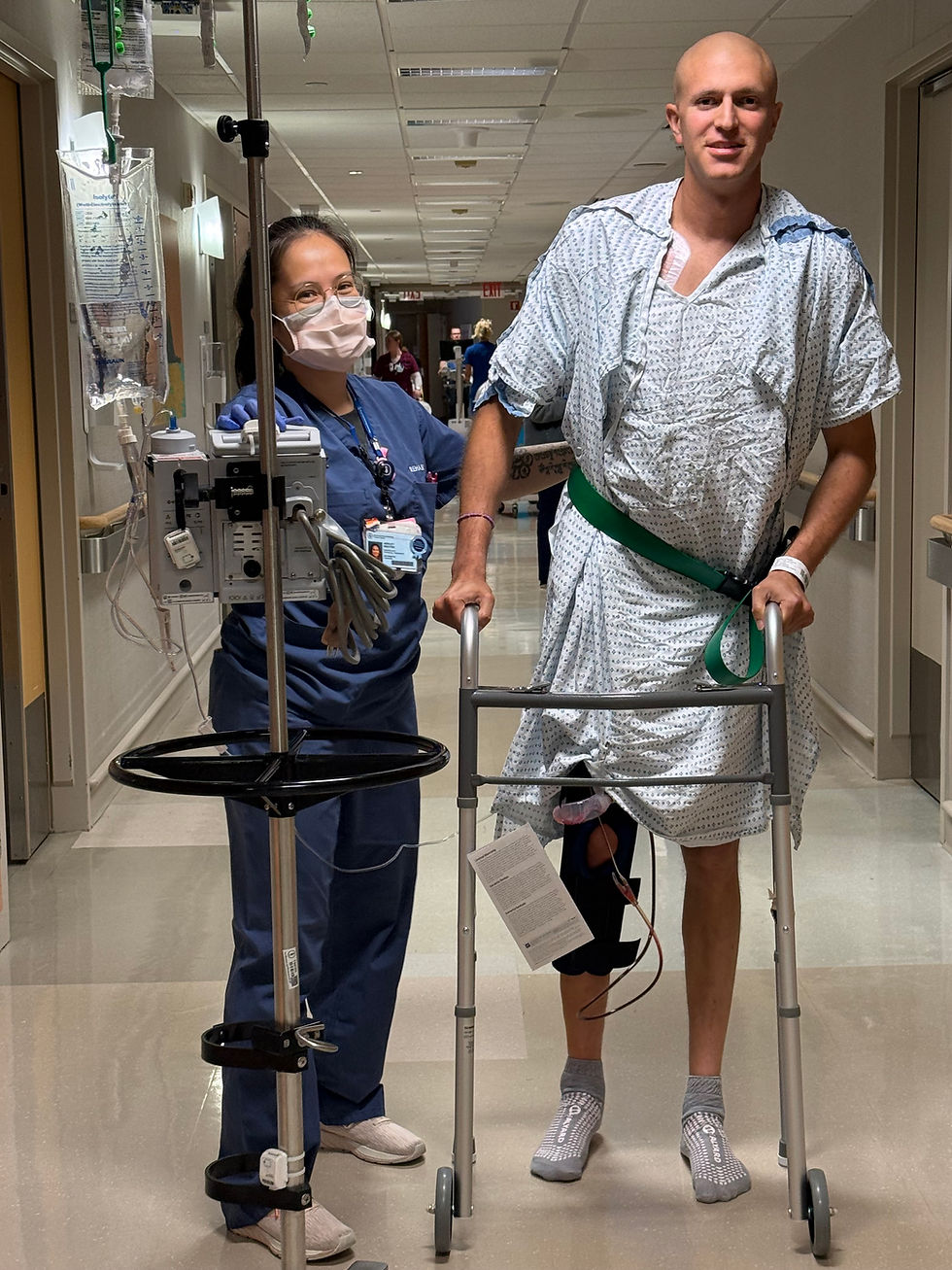
My leg was immobilized, and I could not bend it. Standing for the first time required help from my physical therapist and a willingness to trust a leg that no longer felt like my own.
Progress came in small milestones: standing, using a walker, sitting in a chair instead of remaining in a hospital bed, walking farther, bending my knee, rebuilding strength, and eventually exercising again.
Before surgery, sitting or walking across a room would never have felt like an accomplishment. After surgery, each small improvement represented movement in the right direction.
Recovery taught me that strength is not always measured by how fast or far you can go. Sometimes it is simply the decision to stand up again and keep moving forward.
Throughout this experience, my faith, family, friends, medical teams, and the people who showed up during the most difficult moments helped carry me forward.
Turning Questions Into Action
When I was diagnosed, I began reading everything I could find about CIC-rearranged sarcoma.
I studied published research, contacted researchers and physicians, reached out to biotechnology companies, and searched for potential therapeutic vulnerabilities and clinical-trial opportunities.
The more I learned, the clearer the problem became. Promising discoveries existed, but researchers were often working with limited funding, limited tumor models, small numbers of patients, and few opportunities to move laboratory findings into clinical trials.
Patients were scattered across institutions and countries. Important clinical experiences and biological data were fragmented. Potential treatments could remain trapped between promising research and actual patient testing.
I did not want to accept that rarity had to mean inaction.
Why I Founded Rare But Relentless
I founded Rare But Relentless Foundation while still undergoing treatment.
The name reflects both the challenge and our response: these cancers may be rare, but the patients, families, clinicians, and researchers fighting them are relentless.
The foundation is working to connect the pieces that ultra-rare cancer research often lacks:
Patients who want to contribute to progress
Researchers studying the biology of these diseases
Clinicians who understand how they behave
Institutions capable of conducting collaborative studies
Companies with promising investigational treatments
Funding needed to move discoveries toward patients
Our special commitment to CIC-rearranged sarcoma comes from my own experience, but our mission reaches other ultra-rare sarcomas and cancers facing the same barriers.
This foundation is not simply about my diagnosis. It is about using what happened to me to build something that can help the next person.
“I cannot control why this disease entered my life. I can only control what I do in response.”
Still Moving Forward
My treatment and recovery have tested me physically and emotionally, but they have also given me a clear sense of purpose.
I remain focused on rebuilding my strength, returning to the activities I love, and doing everything possible to give myself and others affected by ultra-rare cancers better options.
I cannot control why this disease entered my life. I can control what I do in response.
That response is Rare But Relentless.
Relentless Research for the Rarest Cancers.

This story reflects my personal experience and treatment decisions made in consultation with my medical teams. It is not intended as medical advice.