
Dorian was only eight years old when what seemed like a minor injury from ninja camp turned out to be stage IV CIC-DUX4 sarcoma. His family was told that his chance of surviving five years was approximately 20%.
Today, Dorian is preparing to get his driver’s license and succeeding in a rigorous International Baccalaureate high-school program.
His story is one of hope, determined advocacy, community, and refusing to accept that the odds define what is possible.
Patient STORY
Dorian's Story
"Witnessing my son Dorian fight this rare cancer inspired me to share our story. We are turning his battle into a relentless mission for hope"- Grace (Dorian's Mother)
A Childhood Injury That Wasn’t an Injury
It all started so simply. Dorian came home from ninja camp with a small, tender swelling just above his elbow. We didn’t think much of it at first; he was an active kid, so a bump or a bruise seemed normal.
We took him to urgent care just to be safe. After a quick look, the staff told us not to worry. They believed it was just a hematoma—a common bruise—and said it would eventually go away on its own.
But it didn’t go away. Instead, the swelling kept growing, day by day. What was once a small bump became increasingly large and painful to the touch. We knew in our hearts that something wasn't right.
About ten weeks after that first visit to urgent care, our world changed forever. After more tests and consultations, the doctors delivered the news we never expected: the growth was likely cancerous.
What we thought was a simple childhood injury turned out to be the beginning of a much harder journey. We quickly learned that in the world of rare disease, things are rarely as simple as they first appear.
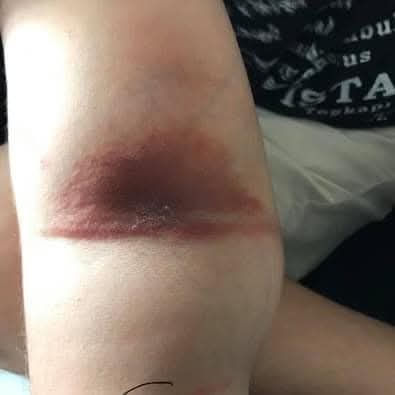
Expected Hematoma into a cancerous diagnosis
Receiving an Ultra-Rare Diagnosis
The initial biopsy results gave us a name: undifferentiated pleomorphic sarcoma. But as we pushed for deeper answers at Children's Hospital of Philadelphia (CHOP), the diagnosis shifted to something even more terrifying and obscure—CIC-DUX4 sarcoma. Our world fractured further when scans revealed nodules in Dorian’s lungs, confirming the disease was already Stage IV.
I will never forget the chilling fear that took hold when one of the doctors admitted they had only ever seen this specific diagnosis once before in their entire career. It felt like we were standing on the edge of a map where the known world ended.
We refused to be casualties of rarity. Our family relentlessly sought out the greatest minds in oncology, consulting with specialists at CHOP, Memorial Sloan Kettering, and Columbia, and reaching out to dozens of other medical professionals across the country.
We were no longer just a family fighting cancer; we were a team searching for a way through a storm that few had ever navigated.
Choosing an Aggressive Treatment Path
Faced with an ultra-rare diagnosis, we knew we had to be aggressive. Dorian began 14 cycles of the Ewing sarcoma chemotherapy protocol, VDC/IE. We were hopeful, but when the tumor did not shrink as much as we needed, the plan had to evolve. Radiation and surgery were added to ensure we were doing everything possible to fight this.
Throughout the process, we were never just passive observers. We spent every spare moment researching, consulting with specialists across the country, and speaking with other families who had faced similar battles. We brought every question and new idea back to our medical team, refusing to leave any stone unturned.
Our advocacy became a vital part of Dorian’s care. By staying informed and vocal, we helped guide several critical treatment decisions. We learned that when fighting a rare cancer, a parent’s voice is just as important as the medicine itself.
Learning From Other Families
When we were first blindsided by Dorian’s CIC::DUX4 diagnosis, the lack of medical literature felt like a dark room. We were desperate for light, and we finally found it through online patient communities. These groups connected us with a small, brave circle of families who were navigating the same ultra-rare path. Because clinical data is so scarce, the shared experiences and case reports from these families became our most valuable resource.
It was through the generosity of another family that we learned about a specific indocyanine dye technique. Their insight changed everything for us. When specialists applied this method, it revealed that the spots in one of Dorian’s lungs were actually nonviable "ghost cells." Because of this discovery, Dorian was spared from an aggressive surgery on the other lung that he might not have otherwise avoided.
We are profoundly grateful to the patients and families who opened their hearts to us. We honor all of them—especially those whose children did not survive this fight. Their willingness to share their journeys, even in the midst of unimaginable grief, provided us with a roadmap when we had none. Their kindness is a gift we will never forget.
Finding a Rare Source of Hope
During our darkest days, I refused to stop searching for a miracle. That search led me to an incredible story of a young woman who had survived stage IV disease. She had received a bone-marrow transplant and stayed in remission without a single relapse. I knew I had to find her.
I managed to track down her family, and through them, we were connected to the dedicated specialists at Children’s Hospital Colorado. Their team offered a level of expertise and innovative thinking that gave us the path forward we so desperately needed.
Dorian was soon enrolled in a crucial clinical trial. The cornerstone of his treatment was a haploidentical stem-cell transplant, with his father serving as the donor. It was a profound moment for our family, seeing a father provide the very cells that could save his son’s life.
His medical team prepared us for a long, difficult recovery, estimating he would need to remain in the hospital for six to eight weeks to recover. However, Dorian’s strength continued to amaze us all.
He met every challenge with such resilience that he was discharged after only three and a half weeks. Seeing him come home so much sooner than expected was a rare and beautiful victory in our long journey.

“Don’t ever let anyone tell you what you’re capable of.” — Grace, Dorian's Mother
Dorian Post Treatment
Supporting Dorian Through Treatment
Supporting Dorian Through Treatment
When we embarked on this journey, we knew that supporting Dorian required a holistic view of his well-being. Alongside his standard medical protocol, our family focused intensely on nutrition, consistent movement, and proactive symptom management. We prioritized his emotional health and leaned heavily on our faith and prayer, while always trying to find small moments of joy and fun to keep his spirits high during the hardest days.
Working closely with his care team, we also explored various integrative and complementary approaches. These choices—including specific supplements, dietary adjustments, acupuncture, and medical cannabis—were made to support his quality of life. We also incorporated therapies like IV vitamin C, infrared sauna, and red-light therapy as supportive tools under medical guidance, though we viewed these as personal choices rather than proven cancer treatments.
Every decision was made in collaboration with specialized professionals to ensure Dorian had the best possible care.
Dorian’s story reflects one family’s personal experience and should not be interpreted as medical advice. Treatment decisions should always be made with qualified medical professionals based on each patient’s individual circumstances.

Holistic/Alternative Medicine approach for Dorian
Where Dorian Is Today
Watching Dorian today is a testament to the power of hope and tireless advocacy. Now a teenager, he is currently deep in the rigors of an International Baccalaureate program and excitedly preparing to get his driver’s license.
Our journey taught us that being relentless means never stopping at the first answer. People told me I should leave dental school to focus solely on his care, but I refused to give up on my own dreams while fighting for his life. I completed my studies and became a dentist, proving that perseverance can thrive even in the darkest times.
His health today exists because we dared to ask the hard questions, sought out expert opinions beyond our local reach, and leaned on the beautiful network of families who truly understand this path.
To any family facing an ultra-rare diagnosis: your voice is your most powerful tool. Stay curious, stay connected, and never stop moving forward.

This story reflects my personal experience and treatment decisions made in consultation with my medical teams. It is not intended as medical advice.